
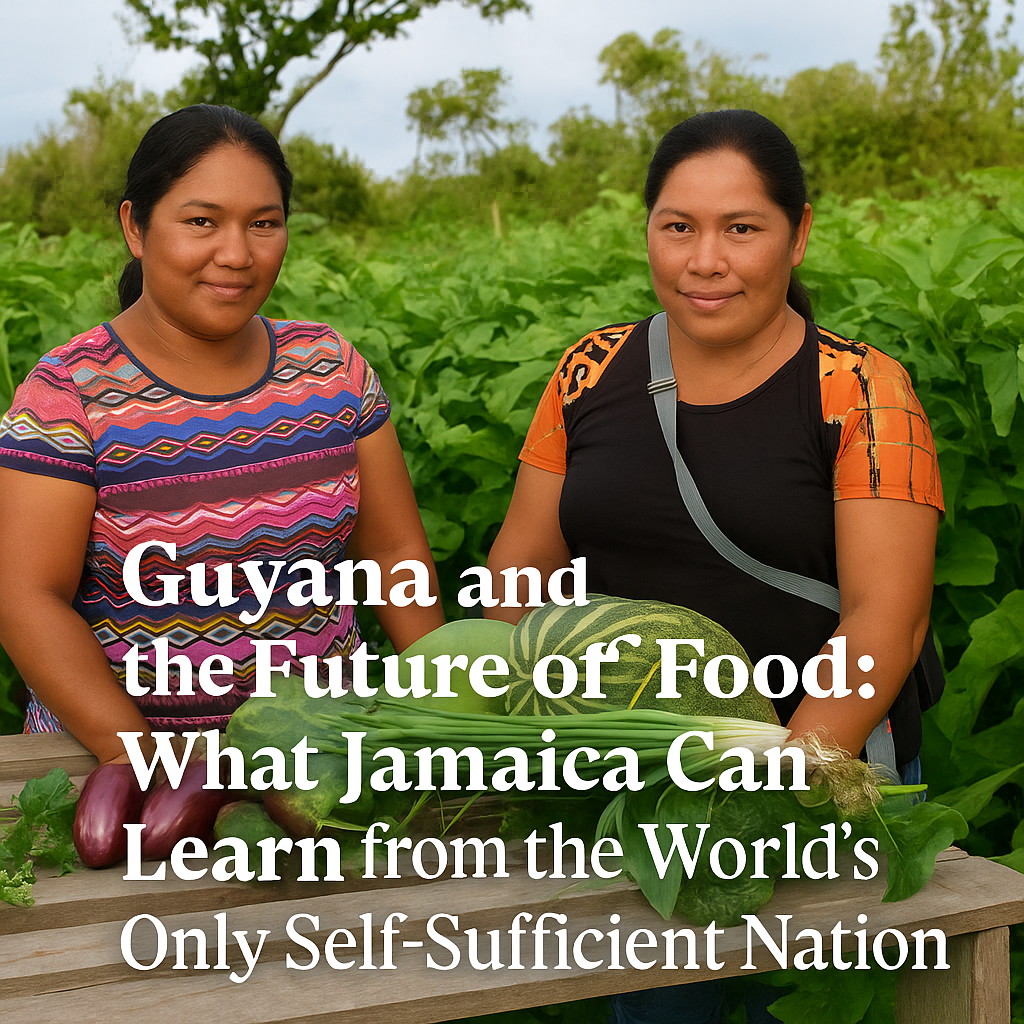
When researchers studied 186 countries to see who could feed their own people from domestic production alone, only one country met the benchmark in all seven key food groups: Guyana.
Fruits, vegetables, dairy, fish, meat, plant based protein and starchy staples. In this study, only Guyana produced enough of all seven to meet its population’s needs under a healthy diet standard. China and Vietnam came close with six out of seven. Most countries fell far short, especially in vegetables and plant based proteins.
For Jamaica, especially after the destruction of farms and fisheries by recent hurricanes, this is not just an interesting fact. It is a practical case study in resilience and long term food security.
Guyana at a Glance: Land of Many Waters
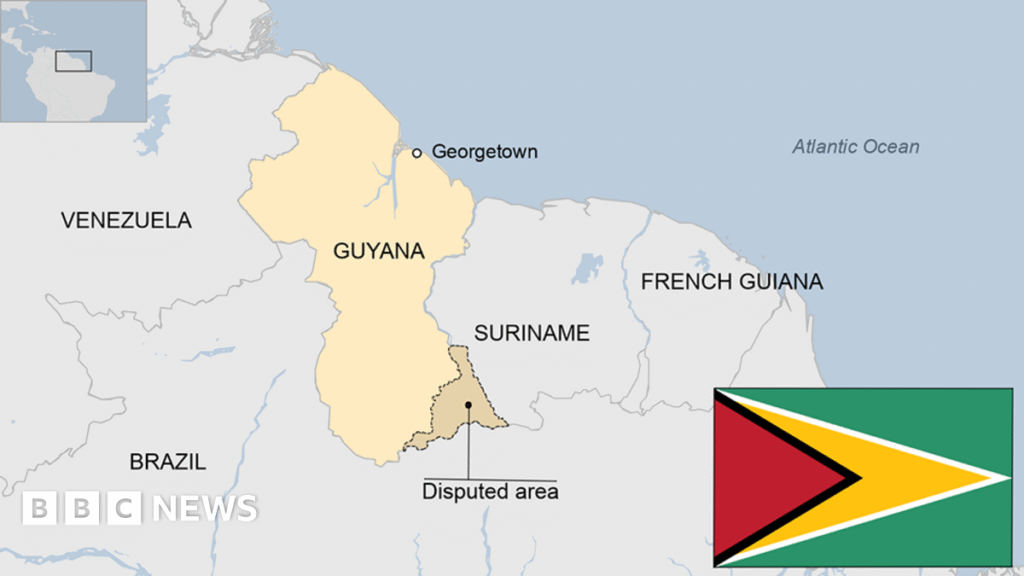
Guyana, officially the Co operative Republic of Guyana, is a country on the northern coast of South America. It faces the Atlantic Ocean to the north, Brazil to the south and south west, Venezuela to the west and Suriname to the east.
Georgetown is the capital and largest city.
With a land area of about 214,969 square kilometres, it is the third smallest sovereign state by area in mainland South America after Uruguay and Suriname. It is also the second least populous sovereign state in South America after Suriname and one of the least densely populated countries on Earth.
Guyana is unique on the continent in another way. It is the only mainland South American country where the official language is English. Most people also speak an English based Guyanese Creole, and many are bilingual in Indigenous languages.
Culturally and politically, Guyana identifies strongly with the Caribbean. It was once part of the British West Indies, is part of the Commonwealth Caribbean and serves as headquarters of the Caribbean Community, CARICOM. It is also a founding member of the Union of South American Nations.
The name “Guyana” comes from an Indigenous Amerindian word meaning “land of many waters”. The country fits that name. It has a dense network of rivers, wetlands and coastal waters, along with a wide range of natural habitats and very high biodiversity. Much of the land is covered by the Amazon rainforest and related forest systems.
Nine Indigenous tribes live in Guyana: Wai Wai, Macushi, Patamona, Lokono, Kalina, Wapishana, Pemon, Akawaio and Warao. Many maintain traditional practices such as shifting agriculture, hunting and fishing and community management of forests and rivers.
From Colony to Oil Powerhouse
For centuries, Guyana followed a path similar to many Caribbean territories.
Before European colonisation, the area was inhabited for millennia by Indigenous peoples linked to the Arawak and Carib cultural worlds.
The Dutch were the first Europeans to establish settlements, founding colonies such as Essequibo, Berbice and Demerara in the 17th century.
After conflicts and treaties, Britain took control in the late 18th century. In 1831, Demerara Essequibo and Berbice were merged into one colony called British Guiana. The economy was based on plantations and relied on enslaved African labour, followed by indentured labourers from India, China, Portugal and other regions.
Guyana achieved independence from the United Kingdom on 26 May 1966 and became a republic on 23 February 1970, remaining in the Commonwealth.
Politics since then have often been tense, with parties strongly associated with ethnic groups. Afro Guyanese have tended to support the People’s National Congress, while Indo Guyanese have largely backed the People’s Progressive Party. This pattern of voting along ethnic lines is sometimes called “aapan jaat” politics, meaning “for your own kind”.
Guyana has also been active internationally. It has served multiple terms on the United Nations Security Council and is a long standing member of the Organisation of American States.
However, Guyana faces a major territorial dispute. Venezuela claims the Essequibo region, which makes up about two thirds of Guyana’s land. Despite an international arbitration award in 1899 that upheld the border, Venezuela revived its claim in the 1960s. In recent years, there have been referendums and military signals from Venezuela, and Guyana has taken the dispute to the International Court of Justice.
Geography, Land and Biodiversity
Guyana lies between about 1 and 9 degrees north of the equator and between 56 and 62 degrees west. It is one of the world’s most sparsely populated countries.
The country can be divided into several natural regions:
- A narrow but fertile low coastal plain along the Atlantic, where most of the population lives and where much of the rice and sugar is grown.
- A belt of white sand and clay further inland that contains most of the country’s mineral deposits.
- Dense rainforests in the interior and south, including parts of the Amazon rainforest.
- Drier savannahs in the south and south west, especially the Rupununi region.
- Interior highlands and table top mountains, including Mount Roraima and other tepuis.
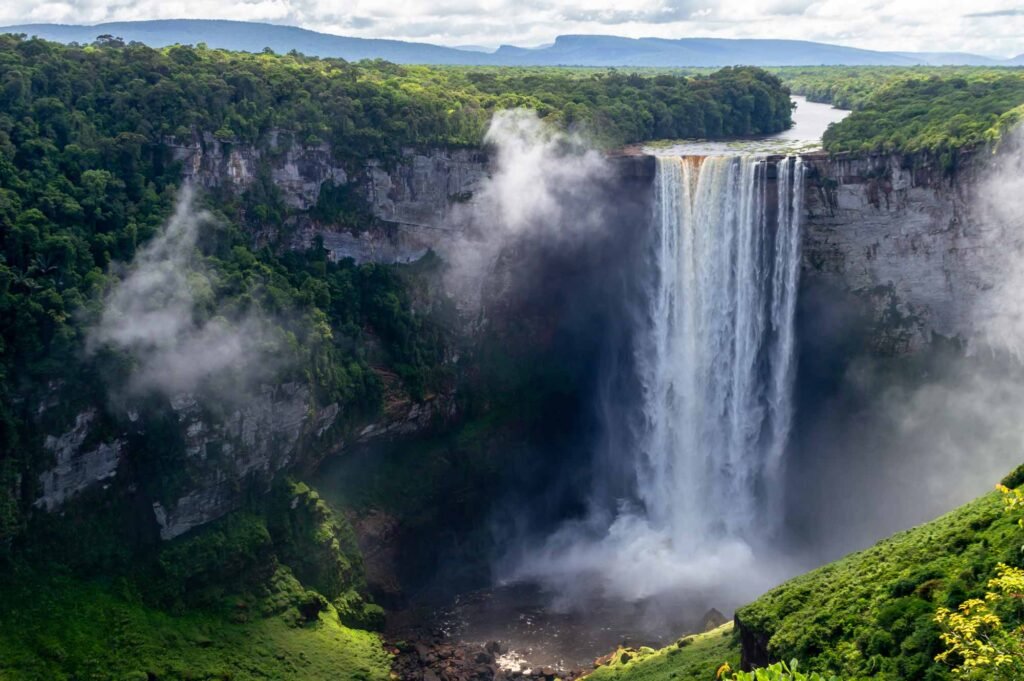
Guyana is famous for features like Kaieteur Falls, one of the most powerful waterfalls in the world, and vast river systems such as the Essequibo, Courentyne, Berbice and Demerara. The Essequibo estuary and Shell Beach on the northwest coast are important wildlife areas, including nesting sites for sea turtles.
The Guiana Shield, which includes Guyana, is one of the most biodiverse regions on Earth. Guyana has hundreds of bird species, large mammals such as jaguars and tapirs, giant otters, a rich freshwater fish fauna including the arapaima and thousands of plant species, many of them endemic. More than eighty percent of the country is still covered in forest, and some areas are almost untouched by large scale human activity.
The country has taken notable steps in conservation. The Kanashen Indigenous District is home to one of the largest community owned conservation areas in the world, managed by the Wai Wai people. The Iwokrama International Centre is another landmark project focused on sustainable use and conservation of rainforests.
Government, Regions and Society
Guyana is a parliamentary representative democratic republic. The president is both head of state and head of government. Executive authority rests with the president and cabinet, legislative power with the president and the National Assembly.
Guyana is divided into 10 administrative regions, such as Demerara Mahaica, East Berbice Corentyne and Upper Takutu Upper Essequibo. Each region has its own capital and local administration.
The population is ethnically diverse. Major groups include people of Indian, African and Indigenous descent, as well as Chinese, Portuguese and other European communities, and many multiracial families. This diversity is a legacy of slavery, indentureship and migration under colonial rule.
Although the economy has grown rapidly in recent years, especially after oil production began, poverty and inequality remain important issues. A large share of the population has historically lived below the poverty line, and the challenge now is to turn oil wealth into broad based, sustainable development without deepening social divides.
Economy: From Rice and Sugar to Oil and Gas
For much of its modern history, Guyana’s main economic activities were agriculture, mining and forestry.
Key sectors include:
- Agriculture, especially rice and Demerara sugar.
- Mining of bauxite, gold and other minerals.
- Timber production.
- Fisheries and seafood, including shrimp.
Rice and sugar are grown mostly on the coastal plain where the land is low, flat and fertile. Systems of canals, conservancies and drainage structures make it possible to farm lands that would otherwise be waterlogged.
Since 2015, the discovery of major offshore oil reserves has transformed Guyana’s economic outlook. Commercial production began in 2019. Oil output grew very quickly and has driven some of the highest GDP growth rates in the world. Guyana is now projected to rank among the top countries globally for oil production per person.
At the same time, international institutions warn that rapid growth from a single export, especially oil, carries risks. These include dependence on one sector, pressure on the exchange rate and local prices, potential neglect of agriculture and other productive sectors and environmental impacts. Guyana faces the challenge of diversifying its economy and using oil revenues to strengthen, not weaken, its food systems and rural communities.
Why Guyana Can Fully Feed Itself
The study that identified Guyana as the only fully self sufficient country in all seven food groups looked at how much food each country produced in 2020 and compared that with the amounts recommended for a healthy diet. It did not simply measure calories, but grouped foods into fruits, vegetables, dairy, fish, meat, plant based proteins and starchy staples.
Guyana is the only country where domestic production met or exceeded the recommended amounts in all seven groups.
Several factors help explain this:
- Land per person
Guyana has a large land area and a relatively small population. This means there is more agricultural and ecological space available per citizen than in most countries, especially island states. - Diverse natural regions
The combination of coastal plains, river basins, forests and savannahs allows for many types of production. Rice, sugar, root crops, fruits, vegetables, livestock, freshwater fish and marine products all have suitable spaces. - Biodiversity and ecosystem services
Intact forests and river systems support pollinators, soil protection, climate regulation and water cycles that benefit agriculture and fisheries. - Agricultural history and infrastructure
Plantation and post plantation agriculture created extensive drainage and irrigation networks along the coast. These systems, while rooted in a painful history, now support large scale rice and sugar production and can be adapted for other crops. - Population size and consumption levels
Because the population is small, the total quantity of food required to meet dietary guidelines is lower than in larger states. Domestic production does not need to match the scale required in large population countries.
It is important to note that Guyana still imports food. The point of the study is that if all imports stopped, Guyana would have the physical capacity to meet recommended dietary needs from domestic production alone. Most other countries would not.
Jamaica’s Food Security Reality
The Caribbean region is heavily dependent on imported food. Most CARICOM members import a large share of their cereals, oils, processed foods and animal feed. Only a few, such as Guyana and Belize, are net food exporters in certain categories.
Jamaica has a long tradition of farming and produces many crops. Yams, bananas, plantains, cassava, fruits, vegetables, poultry, eggs and some pork and beef are important. However, the island still relies on imports for key staples such as wheat flour, rice, animal feed, cooking oil and many processed products.
Recent extreme weather events have exposed this vulnerability. Major hurricanes have destroyed fields, greenhouses, livestock facilities, fishing boats and landing sites. When local supply drops and global markets are also stressed, Jamaica faces rising prices and potential shortages.
The lesson from Guyana is not that Jamaica should seal itself off from trade. International trade allows small countries to access foods they cannot grow easily and to smooth out seasonal or climate related shortfalls. The deeper lesson is that higher domestic capacity makes a country more resilient when shocks occur.
What Jamaica Can Learn from Guyana
Jamaica cannot copy Guyana’s geography or population density. However, it can apply the underlying principles that explain Guyana’s strong performance across all food groups.
1. Treat Agricultural Land as Strategic
Guyana benefits from abundant land. Jamaica’s priority has to be the protection and efficient use of the land it has.
That includes:
- Stronger zoning to protect prime agricultural land from uncontrolled housing and commercial development.
- Investment in irrigation, drainage and soil conservation to maintain productivity on existing farms.
- Policies that discourage leaving good land idle while imports rise.
2. Target the Weak Food Groups
Globally, too few countries produce enough vegetables, legumes, nuts, seeds and starchy staples to meet healthy diet needs. Many rely heavily on imported grains.
Jamaica can:
- Expand production of beans, peas, pigeon peas, peanuts, soy and other plant proteins to reduce dependence on imported meat and feed.
- Increase local production of root crops and tubers such as yam, cassava, sweet potato and dasheen as secure staples.
- Invest in vegetable production using climate smart methods like drip irrigation, protected structures and improved varieties.
The goal is not only quantity but diversity across the seven food groups.
3. Build Climate Resilient Food Systems
Guyana’s intact ecosystems and large forests give it a buffer against some forms of climate stress. Jamaica’s smaller land base and higher population density make it more exposed.
Jamaica can improve resilience by:
- Strengthening hurricane resistant greenhouses, shade houses and storage facilities.
- Improving water management through catchment, irrigation systems and drainage to handle both drought and floods.
- Supporting on farm diversification so that a single weather event or pest does not wipe out all income and food for a household.
4. Use Big Earning Sectors to Support Food Security
Guyana now faces the challenge of making sure oil wealth strengthens agriculture instead of weakening it. Jamaica can apply the same logic to tourism, logistics and services.
Possible steps include:
- Using budget surpluses or concessional financing to fund agricultural roads, packing houses, cold storage and research.
- Creating targeted grants or low interest loans for farmers and agribusinesses to scale up climate smart production.
- Ensuring that tourism development creates markets and partnerships for local farmers instead of relying mainly on imported food.
5. Deepen Regional Food Cooperation Without Overdependence
The study that highlighted Guyana’s unique status also looked at economic unions such as the Caribbean Community. Even combined, regional blocs often remain weak in key food groups such as vegetables and fish.
Still, there is room for Jamaica and Guyana to work together more strategically:
- Guyana can be a major regional supplier of rice, grains, pulses and some meats and fruits.
- Jamaica can focus on high value crops, processing, agro tourism and research and can export to its neighbours.
- Intra regional trade can be improved through simpler customs procedures, better shipping links and coordinated standards.
At the same time, Jamaica should avoid depending on any single external supplier for more than half of its food imports. Diversity of sources remains a key part of resilience.
6. Honour and Use Local and Indigenous Knowledge
Guyana’s Indigenous communities manage large areas of forest and savannah and have deep knowledge of local soils, plants and wildlife. This knowledge supports sustainable food systems.
Jamaica also has rich local knowledge among maroon settlements, hillside farmers, fishers and traditional healers. Integrating that knowledge with modern science can improve:
- Crop choices for particular micro climates.
- Low cost soil and water conservation practices.
- Community level disaster preparation and response.
Conclusion: Resilience, Not Isolation
Guyana’s status as the only country in the recent global study that can fully feed itself across all seven major food groups comes from a unique combination of geography, history, demographics, biodiversity and policy.
Jamaica’s reality is different. It is more densely populated, more storm exposed and more trade dependent. Yet the core message is clear. Building stronger domestic food production across key groups, protecting and investing in agricultural land and infrastructure, using other sectors to support agriculture, deepening but diversifying trade and valuing local knowledge will all move Jamaica toward a more secure food future.
In a world of climate shocks, pandemics and geopolitical tensions, resilience is the real measure of strength. Guyana shows that it is possible for a small country to build a food system that can stand largely on its own feet. Jamaica can take that as a challenge and an opportunity, and shape its own path toward greater food sovereignty and security.