
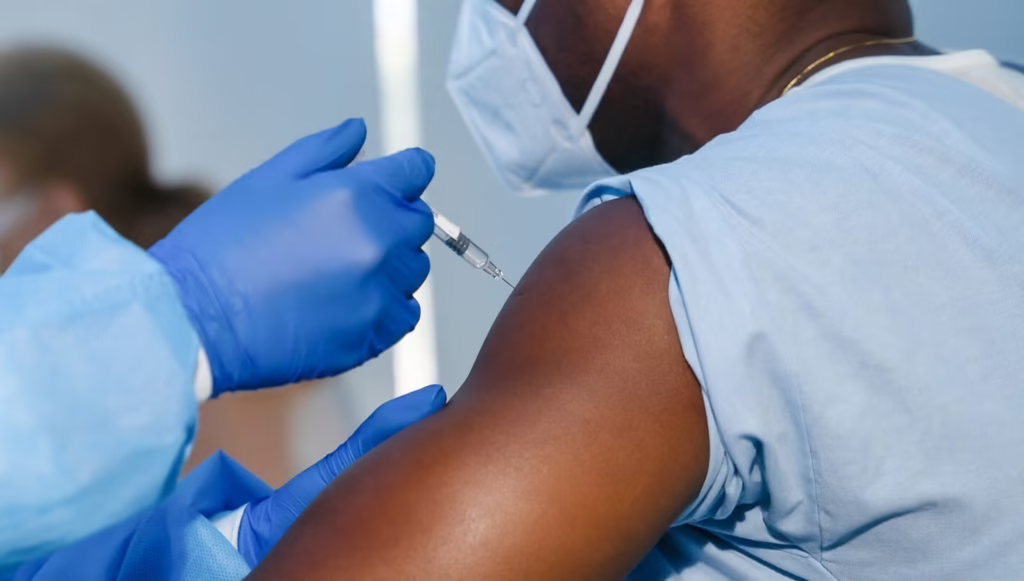
As Jamaica continues to weigh its public health priorities, a quiet but significant debate is unfolding around vaccines and regional influence. At the center of this discussion is the Pan American Health Organization, known as PAHO, the regional arm of the World Health Organization. While vaccines have long been a cornerstone of PAHO’s work across Latin America and the Caribbean, recent global shifts have complicated how openly and forcefully the agency can advocate for immunization.
PAHO’s Role in the Caribbean
For decades, PAHO has played a central role in strengthening vaccination programmes across the Caribbean, including Jamaica. Through technical guidance, disease surveillance, and vaccine coordination, the organization has helped countries reduce or eliminate illnesses such as polio, measles, and rubella. Vaccination has historically been one of PAHO’s most powerful public health tools, protecting millions and preventing health systems from becoming overwhelmed.
In Jamaica, vaccination programmes have generally been stable and widely accepted, supported by a public health tradition that values prevention and community outreach. That history makes the current moment particularly sensitive.
A Changing Global Landscape
Recent decisions in the United States to scale back recommendations for several routine childhood vaccines have sent ripples across the international health community. While those decisions are domestic in nature, their influence extends beyond borders, especially in regions that rely on global health leadership, funding partnerships, and shared scientific standards.
For PAHO, this has created a diplomatic challenge. As a United Nations agency, it must balance scientific advocacy with political reality. Speaking too forcefully risks alienating key partners, while silence or caution can be interpreted as hesitation at a time when clarity is urgently needed.
Why “Mum’s the Word” Matters
The perception that PAHO has softened its public messaging on vaccines has raised questions across the region. Public health experts warn that ambiguity can be dangerous, particularly as misinformation spreads rapidly and vaccine confidence becomes more fragile.
In Jamaica, where trust in health authorities is critical, silence can unintentionally create space for doubt. Vaccination decisions are not made in a vacuum. They are influenced by global signals, media narratives, and the confidence people have in institutions tasked with protecting them.
Vaccines, Trust, and Public Confidence
Vaccines are among the most rigorously studied public health interventions. Their success depends not only on availability, but on trust. When global health bodies appear constrained or cautious, the public may question whether guidance is being driven by science or politics.
For countries like Jamaica, which do not set global policy but are affected by it, the need for clear, consistent messaging is especially important. Public confidence can erode quickly if people sense uncertainty at the top.
Diplomacy Versus Advocacy
PAHO’s challenge highlights a broader issue in global health: how to defend evidence based medicine in a politicized environment. Diplomacy is one of PAHO’s strengths, but public health crises often demand decisive, visible leadership.
The organization now finds itself navigating between maintaining relationships and defending long established vaccine science. How it manages that balance will influence not only policy makers, but parents, healthcare workers, and communities across the Caribbean.
What This Means for Jamaica
For Jamaica, the issue is not whether vaccines matter, but how confidently they are defended. The country’s public health gains have been built on prevention, education, and trust. Any weakening of those pillars, even indirectly, carries risk.
As global debates continue, Jamaican health authorities and the public alike will be watching closely. In matters of public health, silence can speak loudly. The challenge ahead is ensuring that science, not uncertainty, remains at the center of decision making.