
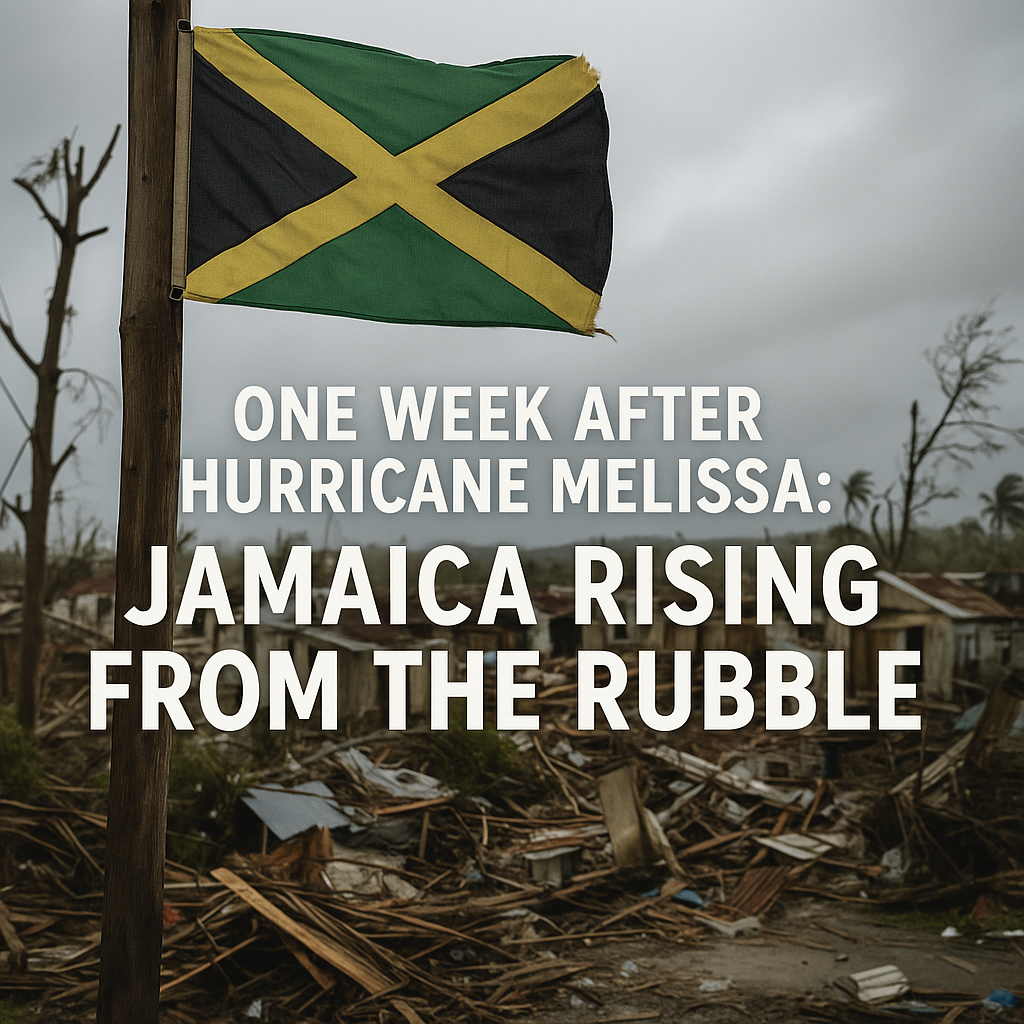
It has been one week since Category Five Hurricane Melissa tore into Jamaica’s southwest coast on October 28, leaving a nation in shock, mourning, and trying to rebuild.
Tonight, the official death toll stands at 32 lives lost, with another eight deaths still under investigation. Behind every number are families grieving, communities traumatized, and a country still coming to terms with the scale of what has happened.
Despite the pain, this first week has also shown something else: a massive, coordinated effort to save lives, restore basic services, and stand with those who lost everything.
Where Jamaica Stands Now
Across the island, crews have been working around the clock to restore critical infrastructure. The Jamaica Public Service Company (JPS) has restored electricity to about 95% of customers in Kingston & St Andrew, Portmore, and St Thomas, and around 90% in St Catherine after damage to nearly 70% of its transmission network. To speed up the recovery, JPS has flown in over 100 additional line workers and more than 60 pieces of heavy-duty equipment from the United States and Canada.
Still, several communities remain in darkness. Areas such as Spanish Town, Guys Hill, Bog Walk, Central Village, and sections of Portmore, Kingston, and St Thomas are expected to wait between three days and two weeks for full restoration.
Communication has been another major challenge, especially in western Jamaica. To address this, the Government has deployed 600 Starlink satellite internet units, prioritizing ATMs, police stations, hospitals, and key government offices to reconnect affected areas and ensure access to emergency and financial services. The medical relief organization Medic Corps has also utilized Starlink technology to restore connectivity in hospitals and health centers.
The Ministry of Labour and Social Security reports that over 30,000 food packages have been distributed to households affected by the storm. This nationwide effort has been coordinated with the Jamaica Defence Force (JDF), Office of Disaster Preparedness and Emergency Management (ODPEM), Food For The Poor, and various private-sector and faith-based organizations.
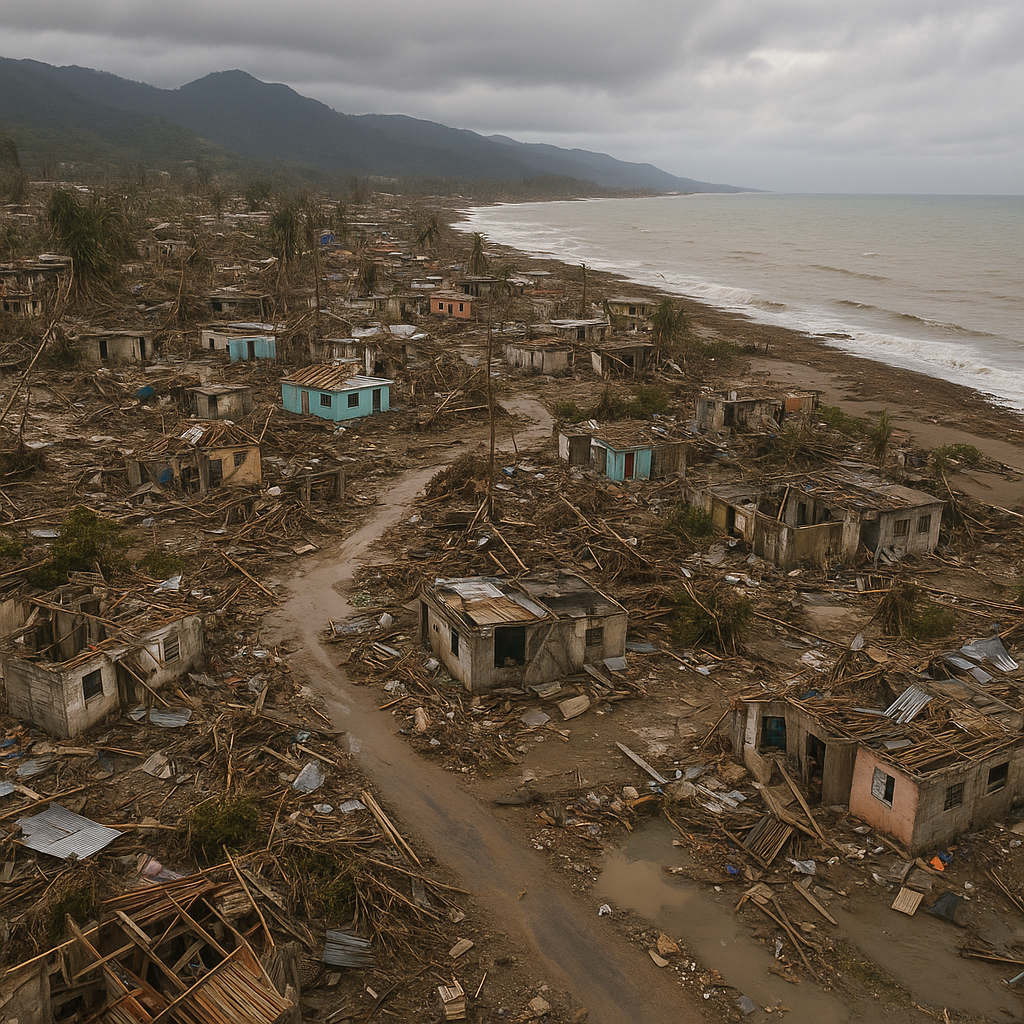
Nearly 15,000 Jamaicans sought refuge in emergency shelters during the storm, with social workers, volunteers, and soldiers deployed across all 14 parishes to provide assistance and counselling. In rural parishes like Westmoreland and St Elizabeth, residents describe entire communities flattened, livestock swept away, and families going days without adequate food as supplies dwindled and shops closed.
Government and National Response
To strengthen coordination, the Government launched the National Registry of Volunteers through the Support Jamaica portal, inviting Jamaicans both locally and abroad to register and assist in relief and rebuilding efforts. A new centralized national relief website was also introduced to streamline donations, updates, and official appeals.
On the education front, 136 schools have reopened in varying capacities less than a week after the storm. Many are functioning as support centers, providing counselling and psychosocial care for children and teachers. The Ministry of Education has announced plans for holiday and summer learning camps to help students in the worst-hit parishes recover lost instruction time. Temporary classrooms, relocation options, and home-learning kits are also being developed in partnership with UNICEF.
The Government has extended key tax deadlines to relieve financial pressure on small businesses, while JDF and JCF helicopters continue search and recovery operations in remote areas. Former Prime Ministers P.J. Patterson and Bruce Golding, along with Bishop Herro Blair, have been invited to guide national and church-led recovery efforts.
In Montego Bay, the St James Municipal Corporation and the National Solid Waste Management Authority (NSWMA) have launched an intensive clean-up campaign. Dozens of tipper trucks, chainsaw teams, and heavy equipment crews have been deployed to clear debris, remove rotting waste, and restore access roads in communities such as Catherine Hall and Westgreen.
Over 300 police officers have been assigned to Westmoreland to help rebuild damaged police stations and ensure law and order during the recovery phase. Meanwhile, Knockalva Polytechnic College in Hanover remains closed indefinitely, with damage estimated at J$3.5 billion—the worst disaster in its 85-year history.
International and Regional Aid
Jamaica is not facing this tragedy alone. In just one week, a powerful wave of international assistance has begun arriving on the island.
The United Nations has allocated US$4 million from its emergency fund to support humanitarian operations, providing temporary shelter, food, and medical supplies to affected communities. The United Kingdom has pledged £2.5 million (US$3.36 million) in humanitarian funding, including water filters, shelter kits, blankets, and a Royal Navy vessel placed on standby for regional support. The United States has deployed a Disaster Assistance Response Team (DART) to coordinate relief operations and logistical aid.
Across the Caribbean, regional neighbors have rallied in solidarity. St Kitts and Nevis donated US$100,000 to Jamaica, while the Cayman Islands committed US$1.2 million in relief supplies and an emergency blood donation shipment. El Salvador sent three aircraft carrying 300 rescuers and 50 tons of humanitarian goods. Trinidad and Tobago, Venezuela, Colombia, and Barbados have all dispatched supplies ranging from food and medical items to rescue personnel and hygiene kits. CARICOM nations have reaffirmed their commitment to unified regional recovery.
Global relief organizations including CORE, World Central Kitchen, CARE, Direct Relief, and the World Food Programme are on the ground providing medical supplies, hot meals, and essential goods. The Inter-American Institute for Cooperation on Agriculture (IICA) has also established an emergency fund to assist in rebuilding the agricultural sector, which suffered extensive damage across the western parishes.
Private Sector and Corporate Support
The Jamaican private sector has responded swiftly and decisively.
National Commercial Bank (NCB) and its partners have raised J$450 million (US$2.9 million) through the “Building a Better Jamaica” fund to help small businesses and homeowners rebuild. Pepsi-Cola Jamaica contributed US$50,000 in beverages, providing thousands of cases of water, Gatorade, and other drinks for relief centers.
Popular restaurant Chicken & Tings partnered with World Central Kitchen to serve thousands of hot meals daily in Kingston and St Andrew. Several companies and media houses have opened collection points for food, clothing, and toiletries, ensuring that supplies reach those most in need.
Foundations, Artistes, and Community-Led Relief
Everyday Jamaicans and public figures have been crucial in keeping hope alive.
The Leon Bailey Foundation was among the first to act, delivering food, clothing, water, pampers, and toiletries to families in Black River and St Elizabeth. The foundation has pledged to expand its relief drive to other western communities.
Emerging dancehall artiste Jay-A Gullyside and his 1Nato team distributed more than 85 care packages to the elderly and displaced families in St Elizabeth. He described heart-wrenching scenes—destroyed homes, flooded graves, and farmers reduced to begging for help.
Masicka’s MADE Foundation launched Phase 1 of a national relief campaign, while Sean Paul pledged to match up to US$50,000 in donations to Food For The Poor Jamaica.
The Government has also announced a national “I Love Jamaica” concert series, featuring Christopher Martin, Masicka, and Nigy Boy, with a target of raising US$1 million for rebuilding and community rehabilitation. The first major event will be a virtual telethon on November 16, with additional concerts planned locally and overseas.
In the diaspora, fundraising efforts have surged. Irish-born Kingston resident Orlagh Kilbride launched a GoFundMe appeal to support charities working in devastated areas like Treasure Beach. The Miami Dolphins Foundation has also used its platform to raise funds for Jamaican hurricane relief.
Within Jamaica’s Chinese Benevolent Association, volunteers have been organizing relief shipments of food, water, and hygiene items for distribution in flood-affected areas across St Elizabeth.
Communications, Finance, and Technology
The country’s technological backbone is being rebuilt. The 600 Starlink satellite units deployed across western Jamaica are restoring vital communication links and helping to power ATMs, allowing residents to access cash for essentials like food and fuel. Jamaica’s two main airports have waived fees for humanitarian flights to fast-track incoming relief. The Tax Administration of Jamaica has also extended consumption tax deadlines to give businesses breathing room during the recovery period.
Civil Society and Climate Justice
Even as cleanup continues, Jamaica’s civil society is urging the world to take notice.
A coalition of 43 local organizations has called for urgent climate justice, declaring that Hurricane Melissa’s unprecedented strength was fueled by global warming and fossil fuel dependence. They argue that Jamaica—like many small island nations—bears the cost of a crisis it did not create. As global leaders prepare for the COP30 Climate Summit in Brazil, Melissa stands as a grim reminder of the vulnerability of Caribbean nations.
The Human Reality
For those living through the aftermath, numbers mean little compared to daily survival.
In Westmoreland, residents describe Melissa simply as “a disaster,” with homes reduced to rubble and families still struggling to find food. In Black River and across St Elizabeth, volunteers recount scenes of heartbreak—boats destroyed by containers, family graves unearthed, livestock rotting in floodwaters.
And yet, through all the loss, a single sentiment echoes across the island:
“Thank God for life.”
Closing: A Nation Unbroken
A week after Hurricane Melissa, Jamaica remains bruised but unbroken. Power is returning. Roads are reopening. Relief trucks are moving again. International aid continues to arrive, and local hands—farmers, students, musicians, and business owners—are rebuilding together.
The journey ahead will be long and demanding, but the heart of the Jamaican people is proving stronger than any storm. When future generations speak of Hurricane Melissa, the story will not only be of the devastation—but of how Jamaica rose again, together.
Support Jamaican books here.